- Inverse Pickering Emulsions Stabilized with Cellulose Nanocrystals: Correlations between Hydrophobic Modification of Nanocrystals and Emulsion Viscoelasticity
- 来源:吴德峰教授个人网站 2026-10-22
Carbohydrate Polymers, 2026,
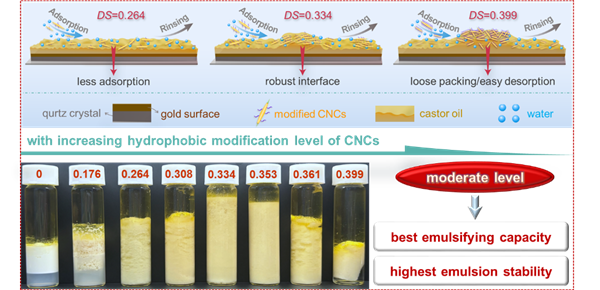
Cellulose nanocrystals (CNCs)-stabilized oil-in-water Pickering emulsion has been widely studied, while the reports on the CNC-stabilized inverse water-in-oil emulsion are quite limited, and the interfacial behavior of CNCs in this system has not yet been fully clarified. Herein, a water-in-castor oil system stabilized with CNCs was prepared as a template for the study. The results showed that the emulsifying capacity of CNCs was not monotonically dependent on the degree of substitution (DS), and the emulsion stabilized by moderately modified CNCs (DS=0.308~0.353, with water contact angle θw=117o~128o) had better interfacial structure and emulsion stability. The interfacial adsorption/desorption and emulsion rheology tests were performed to probe the effect of DS of CNCs on the interfacial activity. The CNCs with low DS (≤0.267, θw<103o) had less interfacial adsorption, whereas the CNCs with higher DS (>0.353, θw>130o) were prone to desorption from the water/oil interfaces. Only those with moderate DS (0.308~0.353) could promote the formation of robust interface. As a result, the inverse emulsion stabilized with moderately modified CNCs presented a minimum interfacial dissipation and the best resistance to a strain-driven bulk deformation. This study can provide a specific guidance for regulating inverse Pickering emulsions by tailoring the surface wetting properties of CNCs.
PDF DOWNLOAD:
- [来源:中国聚合物网]
- 了解更多请进入: 吴德峰教授个人网站
- · Polysaccharide/Polyacrylamide Fluorescent Eutectogels with Enhanced Clustering Triggered Emission for Food Spoilage Detection and Information Encryption
- · Chitin Nanocrystal-Reinforced Fluorescent Carboxymethyl Chitosan Eutectogels
- · Study on Radiative Cooling Performance of Cellulose Nanofiber/Gelatin Aerogels Tuned by Fiber Aspect Ratio
- · Solar-Driven Dye Wastewater Purification and Synergistic Desalination by an Aerogel-Based Multitasking Platform Structured with Polydopamine-Hybridized Covalent Organic Frameworks