祝贺张虎山同学的论文被Inorganic Chemistry接受
Zhang, Hushan; Li, Xiaoman; Wang, Liying; Hai, Xiaoying; Luo, Min,Unraveling the Site-Specific Synergy in Quinary Co-Cu Alloys for High-Efficiency Nitrite-to-Ammonia, Inorganic Chemistry, 2026, Accepted Manuscript .
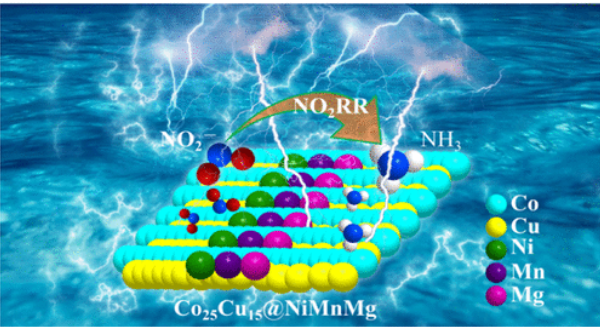
Electrocatalytic nitrite reduction offers a sustainable route to convert hazardous water pollutants into valuable ammonia, yet its efficiency is often stifled by the competitive hydrogen evolution reaction (HER) and sluggish kinetics. Herein, we report the rational design of a quinary alloy catalyst, Co25Cu15@NiMnMg, featuring a distorted face-centered cubic (FCC) structure for highly efficient NO2RR. By precisely tailoring the metal ratios via a sol–gel method, the electronic structure and active site distribution were optimized to break the linear scaling relations. In an alkaline electrolyte, the catalyst delivers an outstanding ammonia yield of 3528.04 μg h–1 cm–2 with a Faradaic efficiency of 96.8% at ?0.5 V vs RHE, significantly outperforming most binary benchmarks. Mechanistically, in situ Fourier transform infrared spectroscopy (FTIR) and electrochemical X-ray photoelectron spectroscopy (XPS) reveal a distinct site-specific synergy: Co sites act as the primary centers for NO2– capture and hydrogenation, while Cu moieties regulate the local hydrogen environment to suppress the HER. Additionally, the Ni–Mn–Mg matrix serves as a structural scaffold to enhance conductivity and stability. This work presents a compelling “multielement synergy” strategy for developing advanced electrocatalysts, offering a dual solution for environmental remediation and green energy carrier synthesis.