祝贺博士研究生周严的研究论文“High-swelling edible cellulose-based hydrogel for gastric filling and satiety induction”被“International Journal of Biological Macromolecules”(IF = 8.7)接受!
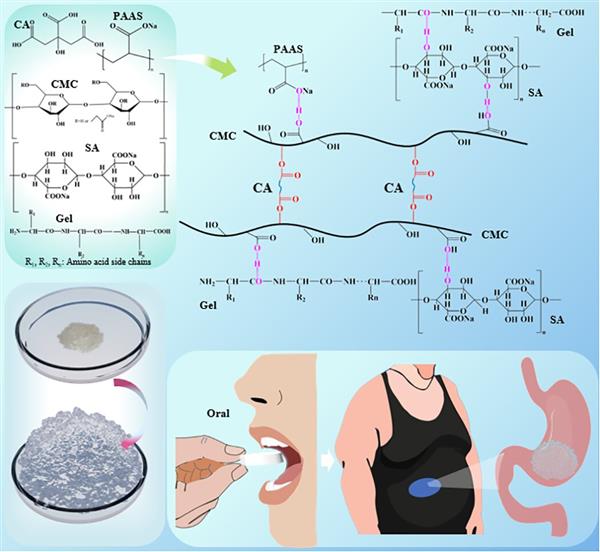
Abstract: Obesity represents a major global public health challenge, seriously endangering human health and imposing a heavy burden on healthcare systems worldwide. In this study, an edible biomass-derived hydrogel was constructed using carboxymethyl cellulose (CMC) as the matrix, citric acid (CA) as the covalent cross-linker, and sodium alginate (SA) and gelatin (Gel) as polyelectrolyte components. The covalently cross-linked CMC backbone endowed the hydrogel with structural rigidity and resistance to gastric acid and gastrointestinal peristaltic stress, while interpenetrating electrostatic complexes formed by SA and Gel improved swelling capacity, flexibility, and biocompatibility. The fabricated hydrogel exhibited favorable cytocompatibility and hemocompatibility, achieving an equilibrium swelling ratio of 195.92 g/g in deionized water (DIW). Its swelling ratios reached 75.16 g/g and 67.40 g/g in simulated gastric fluid (SGF) and simulated intestinal fluid (SIF), respectively. In high-fat diet-induced obese mice, oral administration of the hydrogel significantly reduced body weight (from 32.46 g in the HFD group to 27.53 g in the treatment group), lowered serum levels of triglyceride (TG), total cholesterol (TC), low-density lipoprotein cholesterol (LDL-C), and high-density lipoprotein cholesterol (HDL-C), alleviated hepatic steatosis, and mitigated colonic epithelial hyperproliferation. Notably, the hydrogel also markedly reduced epididymal white adipose tissue (eWAT) weight (from 1.75 g in the HFD group to 0.52 g in the treatment group). Results from 16S rRNA gene sequencing revealed that the hydrogel partially restored obesity-related gut dysbiosis by lowering the Firmicutes/Bacteroidetes ratio.