界面聚合(Interfacial Polymerization, IP)工艺是制备高性能分离膜、功能薄膜和复合膜材料的重要方法,广泛应用于水处理、分子分离和功能界面构筑等领域。然而,在界面限域处发生的反应与扩散现象异常复杂且无定量表征手段而被视为材料化学领域长期未解的难题之一。
近期,香港科技大学杨晶磊教授团队联合加州理工大学William A. Goddard III教授团队,以TEPA(四乙烯五胺)与 HMDI(4,4''''-二环己基甲烷二异氰酸酯)为快速反应模型系统,结合量子化学和机器学习力场从分子层面模拟预测和实验观测验证的双手段,证实了水分子在界面反应中有效降低质子转移能垒的催化机理和反应扩散路径,为深刻理解界面处反应动力学机制与精准调控聚合物膜材微观形貌提供了清晰参考。
2026年3月16日,相关研究成果以 “Interfacial Polymerization of TEPA and HMDI: The Role of Water” 为题发表于催化领域顶级期刊 ACS Catalysis上。文章的共同第一作者为刘碧媛博士和张雍淋博士,文章的通讯作者为William A. Goddard III教授, 杨晶磊教授。文章通讯单位为加州理工学院、香港科技大学。
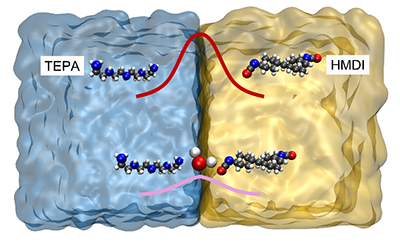
核心发现
本研究结合量子化学计算、分子动力学模拟与实验表征,从分子尺度揭示了水在界面聚合中的关键作用。研究发现,单个水分子并非只是界面环境的一部分,而是能够直接参与反应过程。水分子可在胺基与异氰酸酯基之间构建氢键桥梁,显著降低质子转移能垒,从而加快界面聚合反应。研究阐明了反应更倾向于发生在有机相一侧的分子原因。模拟与实验结果共同表明,HMDI 更稳定于十六烷相,而 TEPA 更容易向界面迁移并发生反应,这决定了聚合主要在有机相侧推进。该工作从理论和实验两方面揭示了水促进界面聚合、界面环境调控反应位置的本质机制,为膜材料界面聚合过程的动力学调控、结构设计与形貌优化提供了新的理论视角。这一发现说明,界面微环境中的水不仅影响反应速率,也可能进一步影响膜层的形成位置、结构致密性和最终形貌。
图文快解
为揭示 TEPA 与 HMDI 界面聚合中的质子转移机制,作者首先建立了具有代表性的分子模型。图1展示了 TEPA、HMDI 及初始中间体结构,其中选取了 TEPA 的伯胺和仲胺位点,以及 HMDI 的两种典型构型,用于表征界面聚合中可能的反应情形。在此基础上,作者进一步比较了无水条件下的直接质子转移与单个水分子参与的桥接质子转移两条路径。图2概括了本文研究的主要反应模型,用于分析水是否能够在胺基与异氰酸酯基之间充当“质子转移桥梁”。需要指出的是,本文并未考虑异氰酸酯基与水的直接反应,因为这一路径能垒较高,在常规条件下难以发生。
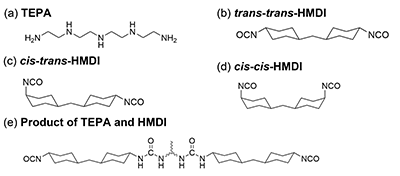
Figure 1. Molecular structures of the IP process studied in this work. (a) Molecular structure of TEPA. (b-d) Three conformers of HMDI: (b)trans-trans-HMDI, (c)cis-trans-HMDI, and (d)cis-cis-HMDI. (e) Representative intermediate formed in the initial step of the reaction between TEPA and HMDI, which ultimately leads to a cross-linked polymer network.
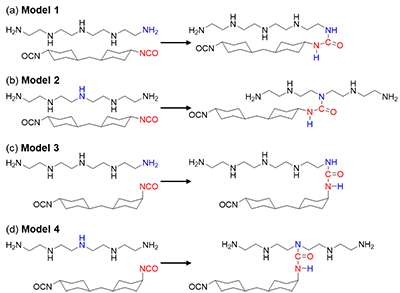
Figure 2. Schematic of the reactant and product for the direct proton transfer reaction between TEPA and HMDI investigated. (a) Primary amine of TEPA with trans-trans-HMDI (Model 1), (b) Secondary amine of TEPA with trans-trans-HMDI (Model 2), (c) Primary amine of TEPA with cis-trans-HMDI (Model 3), and (d) Secondary amine with cis-trans-HMDI (Model 4).
作者系统比较了 TEPA 与 HMDI 在不同环境下的质子转移路径。结果表明,无水条件下的直接质子转移能垒较高,尤其在水环境中更难发生,这与实验中界面聚合快速进行的现象并不一致。相比之下,当单个水分子参与时,质子转移能垒显著降低,反应速率提升多个数量级。也就是说,水分子虽然不是主反应物,却能在胺基与异氰酸酯基之间充当高效的“质子传递桥梁”,从而使界面聚合在室温下快速发生。此外,不同 HMDI 构型和 TEPA 胺位点之间的差异并不明显,说明真正决定反应效率的关键,不是分子构型本身,而是水是否参与了质子转移过程。
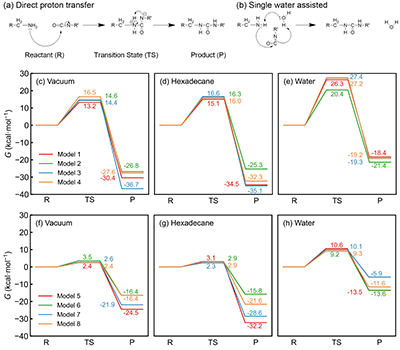
Figure 3. Calculated reaction pathways between TEPA and HMDI. (a, b) Electron-pushing mechanisms for the direct and single water molecule assisted proton transfer, respectively. (c)-(e) Free energy profiles of direct proton transfer in the gas phase, implicit hexadecane, and implicit water, respectively. (R, TS, and P represent reactant complexes, transition states and products, respectively. (f)-(h) Free energy profiles of single water molecule assisted proton transfer. The energies for separated reactants are available in Table S3 to Table S6. Additionally, the energies for reactions (c)-(h) and their corresponding cartesian coordinates are provided in Table S14 to Table S17, respectively.
作者进一步考察了更多显式水分子的影响。结果表明,直接质子转移始终最不利,而有水参与时反应明显更容易发生。整体来看,局部水环境越丰富,越有助于稳定过渡态并促进质子传递。同时,误差校正结果显示这一趋势具有较高可靠性。图4进一步说明,水不仅能作为单个“质子桥”参与反应,周围的微观溶剂化环境也会持续增强其促进作用。
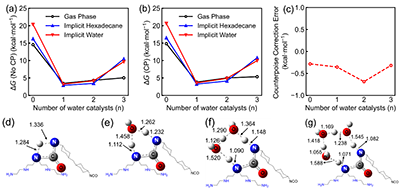
Figure 4. Influence of the number of water catalysts and counterpoise (CP) correction on ?G. (a) ?G for the reaction between TEPA (secondary amine) and HMDI (trans-trans-HMDI) without CP corrections. (b) ?G with CP. (c) Energy differences between results without and with CP correction. (d-g) Transition state structures for the four investigated cases in the gas phase.
水为何能显著促进质子转移?作者进一步分析了反应中的氢键结构。结果表明,无水条件下的氢键作用较弱,不利于质子高效迁移;而单个水分子参与后,可在反应物之间搭建更稳定、更接近理想构型的氢键桥,从而形成更有利的传递路径。分子动力学结果也显示,TEPA 的胺基更容易与水形成稳定氢键,而不会与正十六烷形成类似相互作用。这说明,在界面聚合过程中,真正促进反应进行的是界面附近水分子所构建的氢键网络。
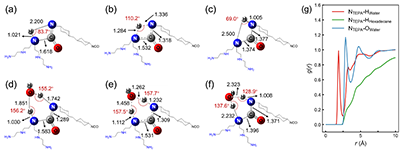
Figure 5. Hydrogen bond structures and solvation analysis for the TEPA-HMDI reaction. (a)-(c) Optimized geometries of the reactant, transition state, and product for direct proton transfer. (d)-(f) Optimized geometries of the reactant, transition state, , and product for single water molecule assisted proton transfer. (g) Radial distribution functions for atom pairs in the water/hexadecane solvated systems.
界面聚合为何更倾向发生在正十六烷相一侧?作者从分子相互作用能出发,分析了 TEPA 和 HMDI 在水相与有机相中的分配行为。基于微调后的 MACE 机器学习力场模拟结果,TEPA 与水的相互作用更强,而 HMDI 则更偏好正十六烷相。这意味着,在界面附近,更可能是 TEPA 从水相向有机相侧靠近并与 HMDI 发生反应,而不是 HMDI 进入水相。因此,图6从分子层面解释了为何聚合更倾向于在正十六烷侧推进。
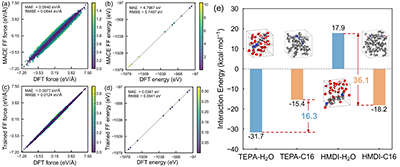
Figure 6. Accuracy of the fine-tuned MACE FF and calculated interaction energies. Comparison of predicted forces (a) and energies (b) between the Original MACE-MPA-0 model and DFT references. Comparison of predicted forces (c) and energies (d) between the fine-tuned MACE-MPA-0 model and DFT references, the corresponding MAE and RMSE values are provided. (e) Interaction energies between TEPA or HMDI and H2O or hexadecane molecules.
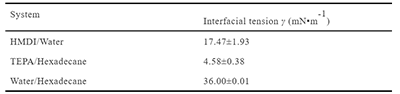
作者进一步结合分子动力学模拟与悬滴法界面张力实验,从分子迁移与界面行为两个层面验证了聚合位置。结果表明,TEPA 更容易在水相中分散并向界面迁移,而 HMDI 主要停留在有机相一侧。这一分布与扩散特征说明,界面聚合并不是在水相内部发生,而是更可能集中在靠近正十六烷一侧的界面区域,与前面的理论分析相一致。
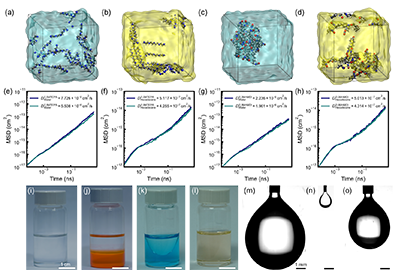
Figure 7. Simulation and experiment-based diffusion and solubility behaviors of TEPA and HMDI in water and hexadecane. (a)-(d) Solute morphologies of TEPA in water, TEPA in hexadecane, HMDI in water, and HMDI in hexadecane studied by MD simulations, respectively. (e)-(h) Mean square displacement curves and corresponding diffusion coefficients of TEPA and HMDI in water and hexadecane obtained from MD simulations. (i)-(l) Experimental observations of solubility behavior. (i) TEPA is completely miscible in water, forming a homogeneous solution. (j) TEPA exhibits phase separation in hexadecane, with hexadecane in the upper layer and TEPA in the lower layer. (k) HMDI forms a hemispherical aggregate in water, surrounded by hydration shells. (l) HMDI is homogeneously dissolved in liquid hexadecane. (m)-(n) Pendant-drop images used for interfacial tension measurements. (m) Water drop in hexadecane, (n) TEPA drop in hexadecane, and (o) HMDI drop in water.
Table 2. Interfacial tensions measured by pendant-drop method at 298.15 K
实验上,作者利用显微成像、荧光成像和微流控实验,直接观察了界面聚合的发生位置与早期反应过程。结果表明,有水条件下界面附近会迅速形成明显反应区,且聚合主要发生在油相一侧;而无水条件下几乎不发生明显聚合。这说明,水在界面聚合中不仅有助于维持稳定界面,更能通过氢键作用直接提升 TEPA 与 HMDI 的反应活性。尤其在反应初始阶段,体系可在 100 ms 内快速成胶,进一步表明表面水分子对 TEPA 的活化作用,是加速界面聚合的重要原因。
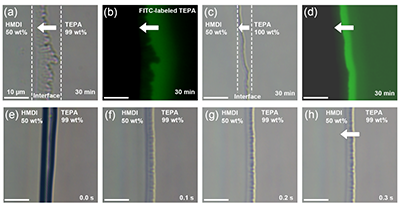
Figure 8. Overview of the formation of interfacial polyurea. (a)-(b) Microscopic and fluorescence images of polyurea formation and clear growth after 30 mins at the interface of the experimental group. (c)-(d) Microscopic and fluorescence images of polyurea formation and unclear growth after 30 mins at the interface of the control group. (e)-(h) Early formation process of polyurea upon direct mixing of 99 wt% TEPA and 50 wt% HMDI with increasing time. The scale bars in panels (b) to (h) are identical to that in (a). The arrows in (a)-(d) and (h) indicates the polymer growth direction.
结果展望
本研究结合量子化学计算、分子动力学模拟和实验表征,系统揭示了 TEPA 与 HMDI 界面聚合的分子机制。结果表明,水分子能够显著降低质子转移能垒,充当连接胺基与异氰酸酯基的关键“桥梁”,从而促进室温下的快速聚合。同时,模拟结果显示,TEPA 更容易从水相向有机相侧靠近,而 HMDI 更倾向停留在正十六烷相中,这从分子层面解释了聚合更可能发生在靠近油相一侧的界面区域。实验结果也进一步验证了这一点:聚合主要出现在油相侧,并在水辅助下表现出更快的反应速率和更明显的凝胶形成。总体而言,该工作揭示了 “水促进反应、油相侧成膜” 的关键机制,总体而言,该工作揭示了界面聚合膜形成过程中“水促进反应、油相侧成膜”的关键机制,为聚酰胺/聚脲类界面聚合膜及其他功能薄膜材料的反应动力学调控、界面结构设计和膜层形貌优化提供了新的理论视角。
原文链接:https://pubs.acs.org/doi/10.1021/acscatal.5c08183
- 吉林大学邹勃教授团队 Nat. Commun.:压致变色凝胶用于机器学习辅助的物理不可克隆光学防伪 2026-05-13
- 江苏大学聂仪晶教授团队 Macromolecules:分子模拟+机器学习双轮驱动 - 高强度高愈合效率氢键自愈合聚合物理性设计新范式 2026-05-06
- 香港科技大学杨晶磊教授团队 Adv. Mater.:机器学习辅助构建界面聚合微胶囊化的定量理性设计范式 2026-01-25
- 郑州大学张亚涛教授团队 AFM:氨基酸辅助界面聚合实现COF膜的反应-扩散用于高性能脱盐 2026-09-14
- 东华大学冯训达课题组《Nature Chemical Engineering》:流体失稳驱动界面聚合膜结构演化的界面流变机制 2026-07-14
- 山东农大刘峰/张大侠团队 AFM:界面聚合过程中油相亲水性对膜形成动力学的多角度影响 2026-02-11